
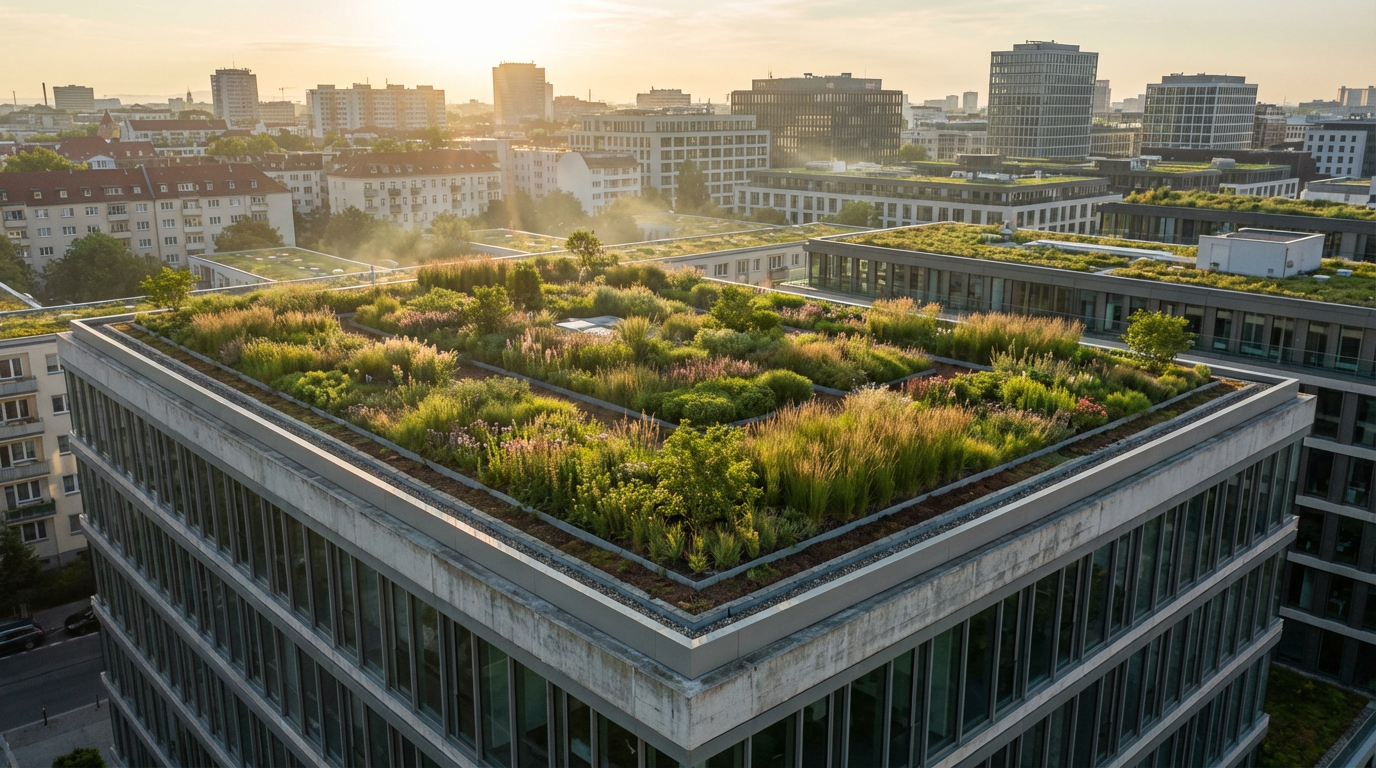
Heavy rainfall, heat islands, parched soils – climate change is challenging our cities like never before. While sewer systems are increasingly reaching their limits during summer thunderstorms, in the same summer, precious water evaporates unused over sealed surfaces. The concept of the Sponge City promises a way out of this dilemma. And it doesn’t start at the curb, but many meters higher: on the roofs of our buildings.
What is a Sponge City?
The term “Sponge City” (German: Schwammstadt) describes an urban development principle where rainwater is absorbed, stored, and then released with a time delay where it falls – instead of being discharged into the sewer system as quickly as possible. Originally developed in response to recurring flood events in major Chinese cities, the concept has now become an integral part of German and European climate adaptation strategies. Berlin, Hamburg, Vienna, and Munich have anchored it in guidelines and urban development plans; the German Association of Cities recommends the Sponge City as a standard model for climate-resilient neighborhood development.
At its core, the Sponge City pursues three goals simultaneously:
- Flood protection through decentralized retention of precipitation during heavy rainfall.
- Heat prevention through evaporative cooling in densely built urban areas.
- Water and vegetation supply through slowed infiltration instead of rapid discharge.
This triad only works if as many urban areas as possible participate – streets, squares, courtyards, parks. And, of course, roofs.
Why the roof becomes a key surface
In densely built-up areas, roof surfaces often account for 40 to 50 percent of the sealed area. If they are constructed conventionally, they discharge rainwater almost completely and without delay into the sewer system. This overloads the combined system during heavy rainfall and, in the worst case, leads to flooding or combined sewer overflows into surface waters.
A green roof reverses this logic. Substrate, vegetation, and drainage layers initially retain precipitation; some evaporates directly, and the rest is released with a delay. Even an extensive setup of 8 to 10 cm of substrate stores between 20 and 50 liters of water per square meter, depending on the structure; intensive green roofs achieve several times this value. At the same time, evaporation cools the microclimate – a green roof can reduce the surface temperature by 20 to 30 °C on hot days compared to a black bitumen roof.
Thus, green roofs fulfill all three core functions of the Sponge City – precisely where the sewer system was previously the only answer to precipitation.
From green roof to retention roof: Where XROOF comes in
Classic extensive green roofs are an important component but reach their limits with today’s required retention performance. Many municipalities now demand throttled outflow rates of 5, 3, or even just 1 l/(s·ha) in their drainage statutes – values that cannot be achieved with substrate alone. This is where retention roofs like XROOF come in: they combine the ecological benefits of a green roof with calculable, engineering-proven water retention.
The principle: Below the vegetation layer, a defined storage volume is created, from which water is released with a time delay via throttles or returned capillarily to the plants. This turns the roof into a doubly effective sponge – one that stores and one that gives back.
This results in three key advantages for planning and approval:
- Hydraulic verifiability: Retention can be precisely measured via construction height, throttle, and storage volume – an argument that makes a difference in drainage applications and discharge permits.
- Reduction or elimination of classic retention systems: Where the roof stores enough, underground infiltration trenches and storage channels shrink or are eliminated. This saves excavation, construction time, and land area.
- Summer evaporative cooling: The stored water is available to vegetation even during dry periods – the greenery remains vital, and the cooling performance is maintained.
How building owners benefit
For private and commercial property owners, a retention roof is more than an ecological statement. The fee models of many municipalities calculate green and retention-capable roof areas at a lower rate for rainwater fees – in large cities like Berlin or Cologne, savings of 50 to 100 percent of this fee are possible. In addition, there are funding programs: KfW, BAFA-related state programs, and municipal green roof subsidies subsidize between 20 and 80 Euros per square meter of green roof area, depending on the city.
The roof membrane itself also benefits. The vegetation layer protects the waterproofing from UV radiation, hail, and thermal stress changes. The lifespan of a professionally installed waterproofing under a green roof is practically estimated at 40 years or more – compared to 20 to 25 years for an exposed roof membrane.
What municipalities gain
From a municipal perspective, the retention roof is a lever with a big impact per euro invested. It relieves the sewer system without civil engineering, without underground approval procedures, and without conflicts with existing utility lines. It reduces heat loads without having to give up parking spaces, traffic areas, or properties. And it creates habitats for insects and birds – an aspect that is gaining increasing importance with regard to the requirements of the EU Regulation on Nature Restoration (NRL).
Where development plans today contain provisions for green roofs, the second step is worthwhile: provisions for retention performance – expressed in liters of storage volume per square meter or as a throttled outflow rate. This is precisely where systems like XROOF become relevant for planning and verification.
Conclusion: Sponge City only succeeds with roofs
The Sponge City is not a buzzword, but a concrete structural response to heavy rainfall, heat, and drought. However, it only unfolds its effect if it includes all urban areas – and roofs are the largest untapped reserve available to us. Retention green roofs like XROOF turn this reserve into a predictable, verifiable, and fundable infrastructure.
Or, to put it another way: If you want to turn the city into a sponge, it’s best to start at the top.
Are you planning a construction project, a neighborhood, or a municipal climate adaptation strategy? Contact us – we will show you how XROOF can be integrated into your drainage and greening plans.